


You hear a faint rustle behind the drywall one night, then a few mornings later, notice what looks like sawdust gathering along a baseboard. By early spring, there’s a wing or two on the windowsill. Most homeowners register these small disturbances before they can name what’s causing them, and the two prime suspects behave nothing alike once you learn what sets them apart.
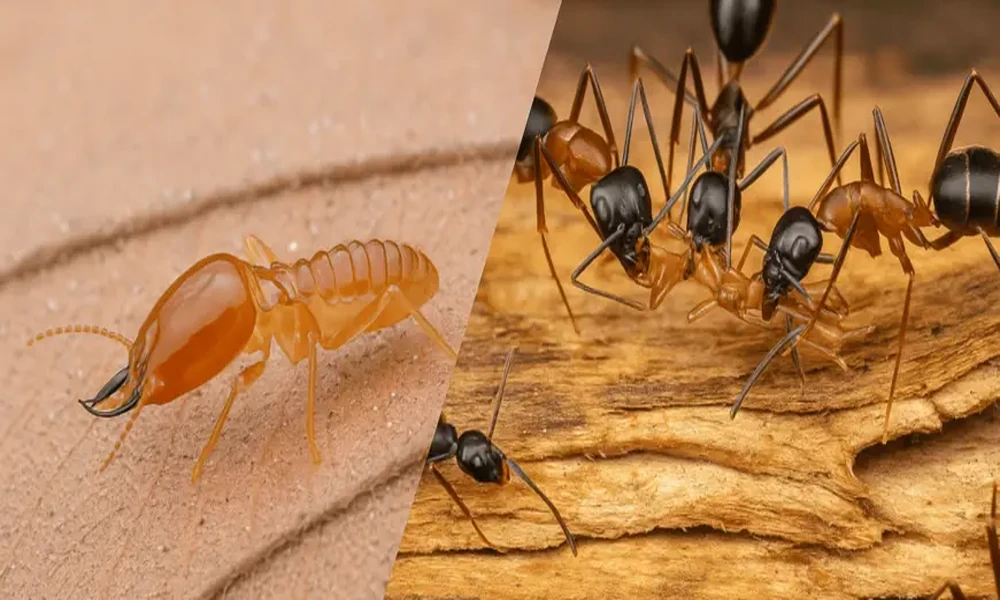
Termites and carpenter ants both go after wood, but only one of them eats it. This difference determines the damage a colony does and the way you have to stop it. Before the guesswork runs away with you, many people ask a licensed team like Palisade Pest Control to confirm the identification, since a treatment built for one pest does almost nothing against the other.
The Wood Keeps a Record
Open up an affected board, and the excavation itself gives you the clearest answer.
- Termites consume the cellulose. Their galleries run packed with soil and a damp, muddy residue, following the softer grain in a rough honeycomb. Subterranean species also build pencil-width mud tubes along foundation walls and pier posts to travel between the ground and their meal.
- Carpenter ants carve without eating. They hollow out smooth, almost sanded corridors and shove the debris out, leaving loose piles of frass beneath each opening. Look closely at that frass, and you’ll spot shredded wood mixed with the discarded body parts of dead ants.
Check The Swarmers On the Sill
Spring pushes both insects into their winged reproductive stage, so a small pile of shed wings indoors is worth a second look before you sweep it away.
- Termite swarmers have four wings of equal length, straight antennae, and a thick, uniform body with no defined waist.
- Carpenter ant swarmers show a pinched waist, elbowed antennae, and a front pair of wings noticeably longer than the back pair.
Why Homes Give Both an Invitation
The conditions these pests hunt for overlap with the way houses age. Shaded siding, clogged gutters, and a slow roof leak keep moisture pressing against wood longer than it should. Carpenter ants gravitate toward timber that’s already been softened by that kind of damp. Termites need only soil contact and a food source, which a mulch bed pushed up against the foundation supplies without much effort.
Neither pest makes its presence obvious. Both can feed for months out of sight before the structural cost finally shows up on your side of the wall, and by then, a small problem has usually become a larger one.
When To Stop Guessing
A homeowner can narrow things down with a flashlight and a screwdriver, but confirmation belongs with someone who inspects these colonies week after week. Palisade has built a strong reputation for the patience its technicians bring to a full property walk-through. They explain what they find in plain language, so customers understand what they are dealing with. This is important since a wrong assumption can let an infestation feed through an entire winter undetected.
A few situations warrant a professional inspection without delay:
- Winged insects showing up indoors again and again, especially near sunlit windows
- Frass piles that reappear after you’ve cleaned them up.
- Hollow-sounding trim, sagging floors, or doors that suddenly stick.
- Mud tubes climbing a foundation, crawlspace pier, or garage slab.
Termites and carpenter ants leave different fingerprints, and telling them apart early spares your home the far bigger repair bill that waiting tends to invite. That rustle in the wall is worth chasing down while the fix is still a small one. Whatever’s behind the wall, a trained inspector can identify which pest it is and get a plan going before another season slips by.